
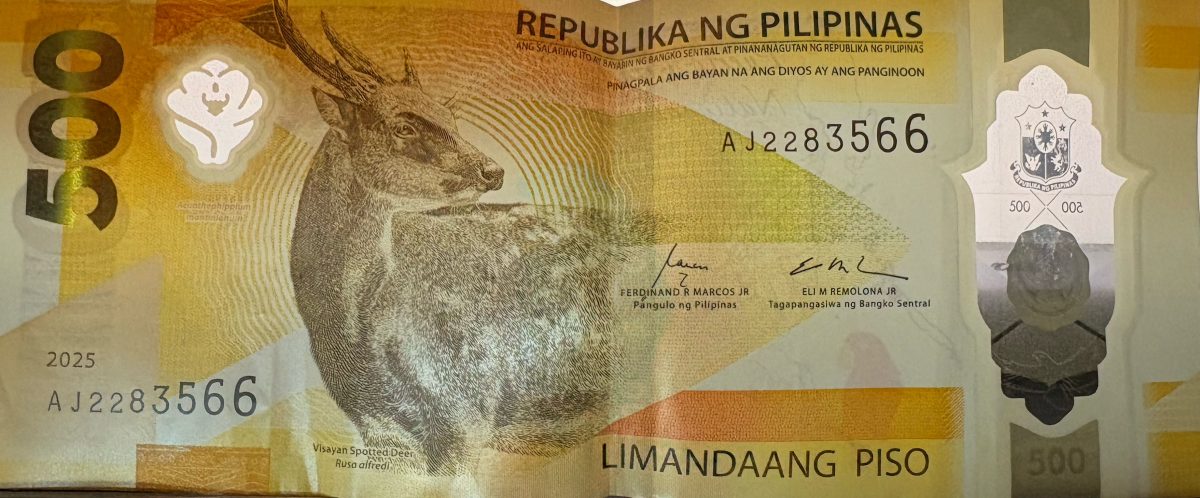
There is some getting used to using a foreign currency when traveling abroad in any country.
“What is it called?”
“What is the symbol?”
“What is the exchange rate?”
Those are all questions that need to be answered. It isn’t at all like an American traveling to Mexico, where they might still accept American dollars, or even Canada, where their dollar is both still called a “dollar” and is similar to the value of one in the US.
The current exchange rate (as I type this) is $1 – ₱63.95 (Philippine pesos). An American has to continually keep this in mind, as the cost of goods will get measured in our minds according to USD. But that is how all measurements work. Here they use meters, grams, and celsius too. I’m always using my calculator (thank heavens for iPhone conversions) to miles/feet, pounds/ounces, and Fahrenheit.
It’s made a bit more complicated by the general economy and cost-of-living here. Basically, many things here are pocket-change compared to the US cost.
For example: I had to go to a medical clinic recently. I had a small infection and knew I just needed some antibiotics. The cost of seeing the doctor, a lung x-ray, and prescriptions basically equalled what you might pay for a decent dinner in the US…not a fancy dinner…but a nicer sit-down dinner. But that was it. There won’t be some bill in the mail a few months from now.
There is a challenge with coins, though. First off, the smallest paper bill that I’ve encountered is ₱50. that means 1,5, and 20 pesos are coins, as well as all the smaller cents (and yes, they are called “cents”). Check out the picture below.
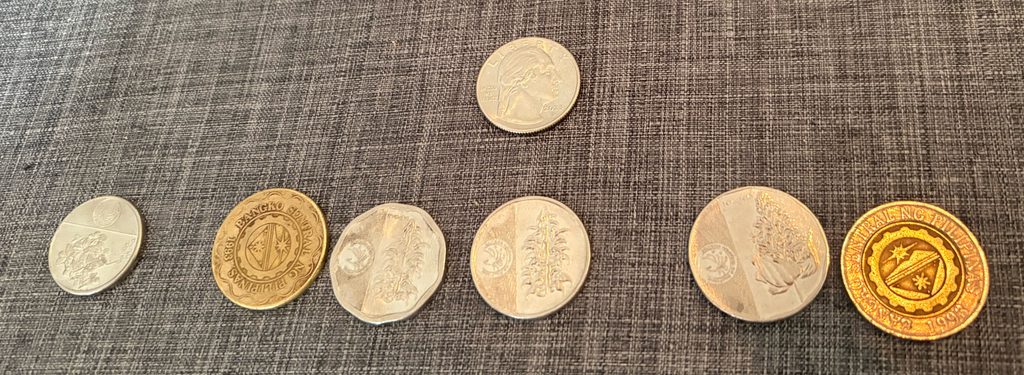
Now, I’ll explain what you are seeing. Yes, that is an American quarter on top, just for scale. I think it is a little bit bigger than the ₱1 coin on the left and the 3 ₱5 coins under it.
Oh wait. In case you missed that, yes there are 3 different ₱5 coins in current circulation and yes, they look different. The left-most one is gold-ish, the middle is shaped like a rounded octagon, and the right of the 3 is just silver and round.
On the right are the two ₱10 coins. Again, yes there are two. That means that you could have 6 very different coins in your pocket, only representing 3 denominations, and they are all different. Confusing?
But wait, there are also ₱20 coins (I think there is only 1 main type you might encounter. Plus, there are smaller cents.
This means that there are always coins jingling around your pocket.
You can also expect numerous places to suddenly let you know that they don’t accept cash, and then you either have to pay with a credit card, or an app on your phone.