A lot has been written about AI. It’s revolutionary. It’s changed/changing/it will change business and life as we know it.
We will all not have to work and receive some sort of Universal Basic Income.
or
We will all fall prey to some malevolent anti deus ex machina, and robo-Arnolds (or Cylons, or the bad guys from The Matrix) will enslave some of us and walk across the skulls of the rest.
But maybe the AI threat isn’t anything we’re even thinking about at all.
Before I begin my treatise here, I have to state two things. First, I feel a bit like a Greek mythological Cassandra here.1 Secondly, every time I write something now, I (like many of us) feel that I need to somehow be less AI-like, or else someone will label it with the modern scarlet letter of “AI slop.” So, for the record, I used no AI help in writing this, although I did use it on a few small things (that I’ll fully cite), like the main image above.
This isn’t a new thought for me at all, but as I was listening to The Briefing with Albert Mohler podcast (I highly recommend), it led to even more thoughts, and then to this article.
Click on each section, to read.
1. What AI is and isn’t
Albert cited an interview very recently that Bill Gates gave on Meet the Press. You can watch it here, if you want.
Watch the 4:52+ mark. He says the following
This is truly an evolutionary event. We have created an intelligent species that in many respects is already smarter than we are, and over the next several years at kind of an exponentially improving level will be insanely smarter than we are.
I don’t doubt that, at least the “smart” part.
I’ve heard it said by an AI use in marketing expert that I was on a conference call with, that AI is your staff expert on biology, or design, or history, or statistics, or anything else you need an expert on. In fact, AI is the smartest doctor you know, and also the best designer, etc. You could devote 30 years to studying a discipline, and still lose to the knowledge that AI has.
The US President has also chosen a new name for AI
Now, we are all used to Trump renaming things. I’m actually somewhat surprised that he went with SI and not TrumpAI (or TAI).
But here’s the thing that Albert Mohler noted, which sparked me. When one considers AI as a new species smart, super-intelligent or otherwise, they are not discussing whether or not it has a moral capacity.
Intelligence (no matter how vast) does not imply wisdom, applied knowledge, which sometimes calls for restraint, even when we know the outcome of a situation, because it is simply the moral thing to do.
Just for a moment, consider how in the days of swords, when a person got beheaded, no one would blame a foil and put the blade on trial. Instead, they would hold the wielder of the blade guilty.
The same goes for the days of muskets, and the days of smart bombs now.
The musket was far more powerful of a weapon than a sword, and the computer-guided smart bomb is more powerful than both of those, but no one blames them for the destruction caused by them.
Similarly no one would give an IQ test to the person firing the gun or pushing the button, in order to assign the level of blame that they should morally have. We instinctively know this (despite the ideas I may be giving to those in the Pacific Northwest). Moral culpability is not, nor ever should it be, a function of intelligence.
AI is not in the sword->musket->smart bomb progression as clearly, but it is an exponential jump in kind. It is a tool. There might come a day that AI will be able to reason morally and therefore be held responsible for its actions…maybe. But that will be the leap that defines it as a species, not superintelligence.
2. What humans are and aren’t
I don’t really know how the world lines up on this although, in the pre-9/11 world I did. I think that humanity isn’t quite sure.
But the fact is that we are pretty crumby.
You and I might not like to hear that, but it’s true. Let’s look at just a few categories from the last hundred years:
History
Without going into vast detail, here is a little infographic2
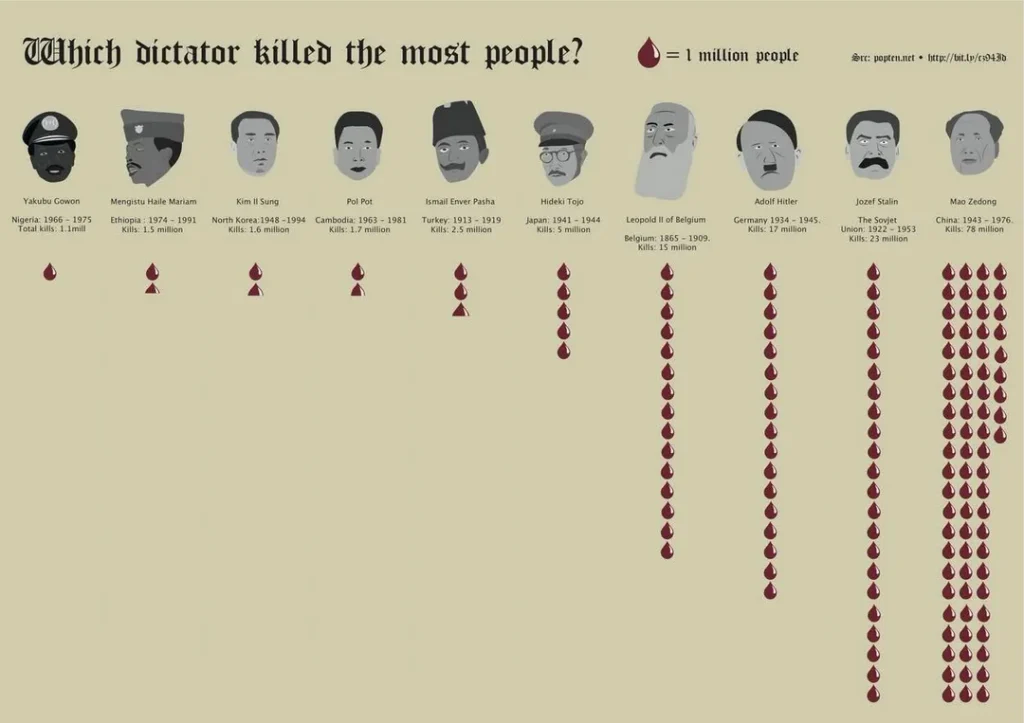
A few other notables are Alexander the Great, Attila the Hun, and Genghis Khan. The first two might end up in the 2 million range collectively. Khan would sit between Stalin and Mao at 30+ million.
Thomas Hobbes described life in a state of nature as “solitary, poor, nasty, brutish, and short.”
War
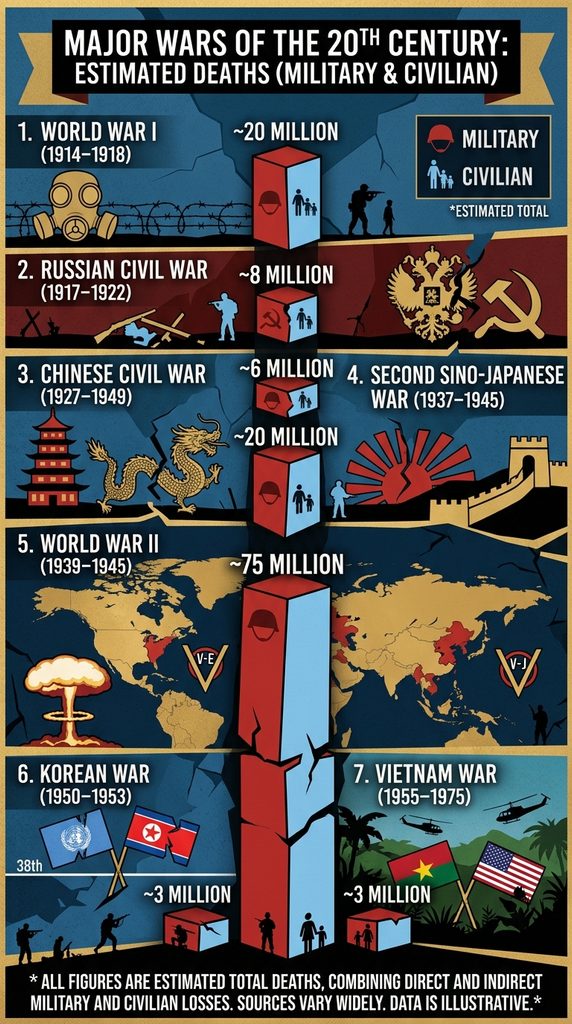
There is no way to account for all war in human history, but just an accounting of the wars over the 20th century that America was involved with look like this.
Political Systems
I do want to point out that the 20th century saw the rise of one type of political system. That system is called Communism.
I know that it is currently a fad in the West to think that Socialism is cool, but according to Marxism, Socialism is just a low phase, which leads to Communism in the long run. I know that pro-Socialism people might not like to hear that, but that is the simply the case.
I know that it is currently a fad in the West to think that Socialism is cool, but according to Marxism, Socialism is just a low phase, which leads to Communism in the long run. I know that pro-Socialism people might not like to hear that, but that is the simply the case.
Do you notice a trend at the top of that listing of dictators who killed the most people list? That’s right, they are all Communist. In fact, when you realize that Adolf Hitler’s Nazi party was named as a nickname for the National Socialist German Workers Party, even though the Nazi’s were vehemently anti-communist, then Hitler should be included in the list of Socialist/Communist leaders who made the last century very bloody.3
My point in this is actually not to rail against any political system, but to point out that political systems which have been created by man out of a materialistic sense, and a focus on humanitarianism have created a trail of blood every single time. The last century is littered with the flotsam of very human political regimes.
Socio-Communism, at it’s heart says that humans are in their very nature good, but people are pushed down by other greedy people who don’t want them to flourish.4
This is what humans do. Any thought of a human created paradise might seem grand, but is pretty foolish. I think of a quote from Lincoln which seems especially true here.
At what point then is the approach of danger to be expected? I answer: If it ever reach us it must spring up amongst us; it cannot come from abroad. If destruction be our lot we must ourselves be its author and finisher. As a nation of freemen we must live through all time or die by suicide. – Lincoln’s Before the Young Men’s Lyceum of Springfield, Illinois January 27, 1838
Actually, that’s really apt. We’ll come back to that later.
3. What we do, and what we ARE doing
I’ve been in marketing for a long time, and generally in business for even longer. I also come at this issue from a foundation of faith, that forms a lens through which I see everything in the world. It makes me see this issue a bit differently.
I don’t have this utopian view of computer intelligence because it’s human-built, using our logic. That means that it is flawing by sin in its very nature. This is because we created it in our image, and our image is flawed.
Even if you don’t share my biblical and theocentric foundation, you are not blind to history. Look at all utopian dreams throughout history and how they all turned out. It isn’t a good track-record.
This is something that I’ve thought about for quite some time, and tried to remove myself from the hype on both sides. Maybe it’s pretty obvious and I’m not as brilliant as many experts. But, I do enjoy watching it play out.
We can see it happen in the business world.
For many years, there were piles of snail mail in our mailboxes, and more and more frequently it started being about trying to sell something. It got increasingly creative. Ads started to look like important bills. Envelopes would tell us things like “Money Inside.” They even started using fonts that looked like they were hand-addressed.
Heck, there are services your company can pay that will hand-address envelopes. There are also machines that physically hold a pen and make the pen impressions, so that it will mimic a handwritten address. This happened so much so, that people began ignoring their mailbox almost entirely.
Then with the advent of email, it wasn’t too long before companies that were vying for you attention moved on to that. Spam started flooding inboxes with increasingly more clever ways of getting our attention.
“Click here.” “Do you have a quick 15 minutes?” It went on and on. Companies started realizing that they could make money selling their subscriber list. Then people stopped checking their email about as much as they stopped paying attention to their physical mailbox.
Facebook is full of scam videos. I know, because I’ve had to have long and tearful conversations with my mom, explaining about how Dr. Phil hasn’t discovered a cure for this disease or that, etc.
There are deepfake videos using the AI-created likenesses of dozens of celebrities. Joe Rogan has talked a lot on his podcast about discovering that he was the frontman for products he’s never even heard of.
Youtube is mostly AI-created content now. Have you tried searching for something like “worship music” recently? You might see something similar to this.

Whatever genre you type, this will be mostly what you see, or some version of it. You see, these are all AI generated. They aren’t the actual artists. They are just click-farms, and since they keep eyeballs-&-ears, and mean more money for YouTube.
I’ve investigated it, and YouTube does demonetize them, but doesn’t take them down. That means more money for YouTube, and less paying out. It also means less money for the artist.
It’s a corrupt system.
I got this message on LinkedIn lately:
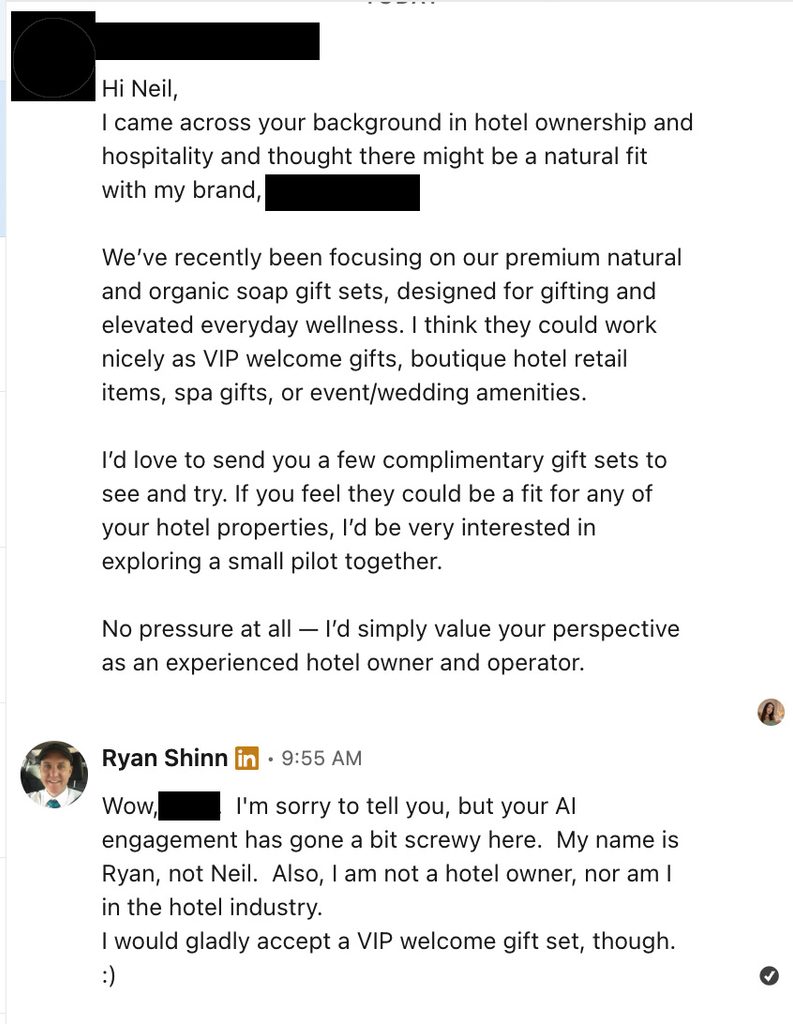
You are right, if you are noticing the pattern. Due now to the increase in what the industry calls AI Engagement tools, people are increasingly ignoring messages from LinkedIn now too. I’m not even paying attention to many LinkedIn messages lately (especially when they start with “Neil”) and neither are you.
But the problem is not the AI engagement tools anymore than it was the fault of the machine that holds a pen. We are making AI in our image, and we have a self-interested and flawed image.
4. There is a darker side to what we are teaching AI
Above, I described how business is selfishly using more and more technology to push its selfish goals. But business is run according to capitalism (even in Communist China), and therefore must operate according to self-interest.
But, there is a much darker side. As I mentioned in the above section, there are scammers using AI to make celebrities endorse things that they would never endorse. These robo-celebraities hawks their “revolutionary” wares until the video gets taken down, then they created something new entirely.
The humans behind it don’t care. They live either in place that are so populous and the authorities are too spread thing (like in India), or places that unofficially give the nod to scam other countries and then do nothing to go after their own citizens (China).
Sometimes, those countries even put those scam centers even more out of the way countries where they can claim to have no ability to enforce the law (again China).
Either way, these hackers are using increasingly sophisticated AI tools to scam people. Here are a few common ones:
- Pig Butchering Scam – You might see this in an online dating app, or most frequently it’s a wrong-number text. You’ve probably gotten a lot of those. I know I have. I think they’re kind of fun. I got one recently that said “Are you in Seattle yet?”5
For the record, I am not from Seattle and had no plans to go there. So, most people would respond with “I’m sorry. Wrong number.”
You’d get a message back, and it would be something like, “Oh, I’m sorry. I was trying to message my friend, Beth. I’m Penelope. What’s your name?”
Over time, you would learn that Penelope is an immigrant from a country in Asia, she’s a powerful business woman (probably a fashion-designer), and she makes a ton of money investing in Crypto-currency. She will send pictures. She will like many of the same things you like. It will seem very very real. None of it is. She’s almost certainly a middle-aged man who is using very sophisticated AI tools to research who you are, create imagery, and seem like a fairy-tale.
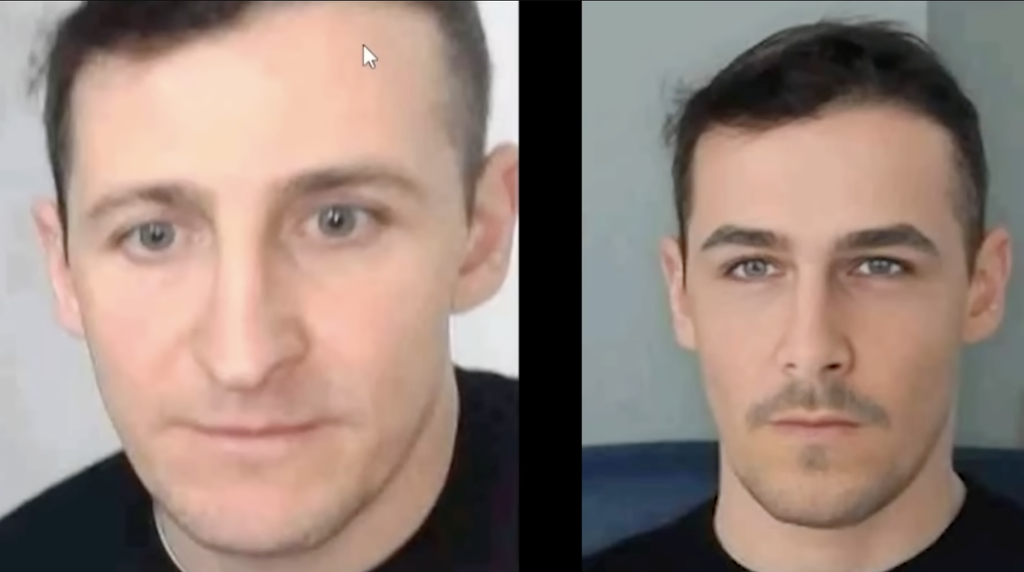
If she lives in Los Angeles, she will show you pictures of her stuck on the 405 in traffic, eating a french-dip at Phillippes. After months, she’ll naturally share her online portal she uses to invest in Crypto…or so you think. If you put money in there, she’s gone…poof…so is your money. - AI Filters – There are a lot of scams that use AI filters, from men who use those filters on their video and audio in order to catfish other men, to scam call centers who hide the identity of scammers even on camera, they are good, really good…and they are getting even better. Right now, there are a few tricks that you can use to find out,6 but coming are the days when it all might be too good to trick. Here is a real example of one of these in action.7. The real person is on the left below. The right is the AI filter in action.
- AI kidnapping – There’s an old scam, whereby kidnappers claim to have taken someone’s child/grandchild and demands ransom money, or they will hurt the kidnapped person. The kidnappers could text the victim a picture of the kidnapped person. Now the kidnappers can use AI voice emulation using any public audio record to make the person, in order to make the victim believe that their loved on in really taken. They can and do also use AI deepfake videos and image creation.
On LinkedIn, there are scams offering work to people from AI tools. These tools have scanned recent posts, pictures, and video in order to engage with the mark and make him/her feel that someone is actually impressed with their “thought leadership.”
Then invariably, the scam message will try to get the person to contact them on WhatsApp or Signal (or some other messenger).
Don’t fall for this.
My point to all of this? Scammers are busily using increasingly complicated AI tools that are being trained to scam us.
5. What we are training AI to do
I see 3 major paths of concern here.
In his podcast, Albert Mohler was pointing out that AI cannot be morally culpable for what we have trained it to do.
If AI scams people, it is because we have built that.
If AI treats people like means to an end, it is because we have built that too.
If we look at AI as just an a thing…maybe even a really amazing thing, it is not culpable of moral or immoral behavior. If someone get’s stabbed, they don’t call for the police to arrest the knife. If some’s house is destroyed in a bombing run, they don’t call for justice against an airplane.
At the same time, AI is a really incredible tool, in the right hands, and a really devastating one in another’s. The big question there, is the democratization of the hands that wield it.
But it’s really no different for those that are saying that AI has or will achieve Artificial General Intelligence. If you have a child who steals from the local store, it is often the parents that get in trouble. It’s the parents after all, who are training the child hopefully to act like a responsible adult. So, it still wouldn’t be the fault of AI.
Which gets us to the 2nd thing that concerns me about a future with AI, what humanity is teaching it.
As a business tool, we are teaching it to use flattery in order to convince people to advance a goal. It is obvious that no matter what you think about machine learning. It is learning. I worry about this more than about us using AI to do better scams.
If you talk about certain ways to cheat people and earn money illicitly, reputable companies will balk. But there are companies that are seen as reputable that use AI in order to flatter and drive engagement to a goal. I wasn’t thinking about this, but my own conversations with Claude have made me realize that even though this is softer, it is still manipulation and equally using others as a tool to achieve a goal.
The third one is harder to pin down. It is all about image. AI is studying the writings of humans in order to learn. That’s scary, a bit. We are people of paradoxes, hypocrisies, and expectations. We are arrogant, and angry, and deeply loved. I don’t know if AI is capable of understanding that last part. I sure hope so.
But, even though I sound like a pessimist (at least in the short term), I’ve read the last page of history, and something tells me that we will be alright.
- look it up, if you need–I feel very literate for that reference. Just give me that one. I need it to feel special. ↩︎
- I did use AI to create most of these for convenience. I did verify the numbers were reasonably correct, although historians will heavily argue. ↩︎
- If you happen to read the Nazi 25 point plan, it is VERY clear that they are socialist. ↩︎
- I see the obvious incongruities and paradoxes that any honest observer notes too. ↩︎
- In this case, I responded with “No, I’m delayed, but my flight arrives tomorrow morning. I’ll see you then.” ↩︎
- Like asking people to hold up 3 fingers in front of their nose. It breaks the AI filter for a moment in those areas, making the fingers seem to disappear or slightly revealing the true face behind. ↩︎
- Jim Bowing’s video Unmasking the deepfake scammers ↩︎